The Rise and Fall of the Route 66 Museum
An Arizona Route 66 Centennial Presentation
Presented by Ken Zoll
Friday, September the 11th at 4:00pm
Complimentary Reception to Follow
Located at VVAC
“Route 66 has become a symbol of the heritage of travel and the legacy of seeking a better life shared by the people of the United States, and because Route 66 has been enshrined in the popular culture of the United States” -- Public Law No: 116-256
As part of Arizona’s year-long celebration of the Centennial of Route 66, Ken Zoll, author of H.H. Nininger: Master of Meteorites, and VVAC’s Director Emeritus will present the story of “The Rise and Fall of the Route 66 Meteorite Museum.”
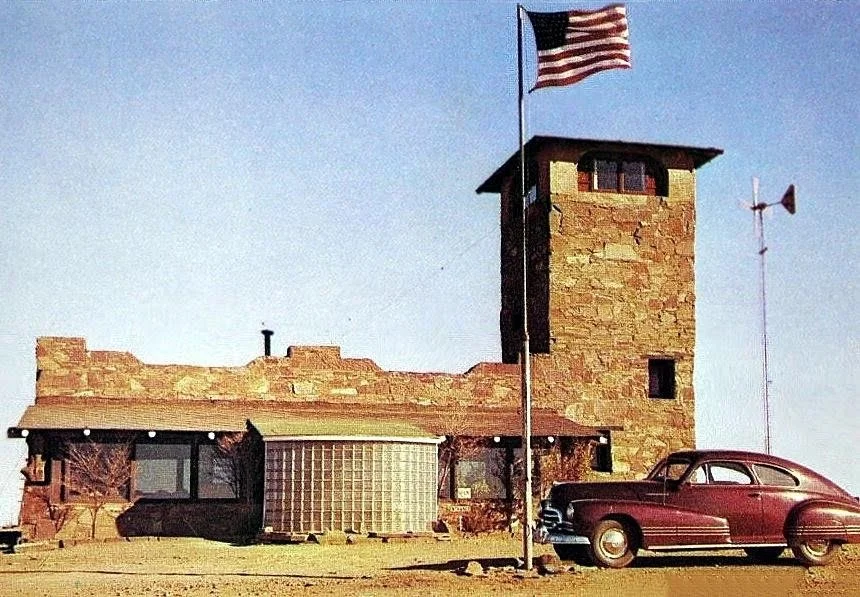
After World War I, Harry William Locke and his wife, Hope, traveled around the country and eventually found themselves at Meteor Crater in the 1920s. Locke was fascinated by the crater and soon became a fan and promoter of the crater. They homesteaded 640 acres north of the crater at the intersection of Route 66 and the road to the crater. Locke built a service station on a portion of the property and opened “Meteor Station,” a cafe and gas station, hoping the business would fund their life’s dream - the building of a meteor museum. Needing funds to build a museum, he leased Meteor Station in 1936.
Locke started to build his “dream museum,” with a viewing tower, south of the gas station. At that time, the crater was being actively mined, and tourists were not welcome. Meteor Crater Observatory opened in July 1936 as a museum and rock shop with a tower where visitors could use a telescope to view Meteor Crater. Unfortunately, the opening of the Observatory was not timed well as this was still during the Great Depression, so paying visitors were too few to support the Observatory. The enterprise closed in 1938.
In 1946, Harvey H. Nininger, regarded as the “Father of American Meteoritics,” and his wife Addie, moved near Meteor Crater from Denver. They wanted to create “the first and only museum of its kind, and it would be run on a high, educational plane.” He leased the former Observatory to establish the American Meteorite Museum, however, his timing was also unfortunate. The new Interstate 10 highway opened in June 1949, bypassing Route 66, resulting in a drop in visitors and income. Unable to sustain the museum on Route 66, they moved to a new building in Sedona in 1953. Not yet a “tourist town,” by 1957 it became obvious that the museum was not going to survive. The meteorite collection was sold, and the museum closed, in 1958.
Following the talk join us for a complimentary reception with hors d’oeuvres, wine,
and non-alcoholic beverages.
This talk is free and open-to-the-public.
Seating is available on a first-come, first-served basis.